
The World Scholar’s Cup (abbreviated as WSC) is an international team academic program with students participating from over 82 countries. The competition was founded by DemiDec, in particular by Daniel Berdichevsky, DemiDec’s president, in 2006. The World Scholar’s Cup has attracted what it calls “a global community of future scholars and leaders”, and promotes that it allows participants to “discover strengths and skills you never knew you had.” It focuses on bringing students from different cultures together to discuss issues and ideas relevant to today.


Another common occurrence during World Scholar’s Cup tournaments is the echoing of the word “Pwaa”. “Pwaa,” explains Berdichevsky at the start of every cup, “is the sound that a happy alpaca makes.”
Often used as an interjection or a response to a statement, this onomatopoeia has become a sensation among World Scholar’s Cup participants. It may also be used in a call-and-response format, as demonstrated by staff members at many competitions. Often, staff members will call out the word and find themselves echoed by hundreds of students. The word has also made appearances in Facebook statuses, and at the 2011 Global Round in Kuala Lumpur, Malaysia, Deputy Prime Minister of Higher Education in Malaysia Dr. Hou Kok Chung Saifuddin Abdullah used it during his closing remarks. The word “Pwaa” is used as a pun in various places during the contest.
Examples of usage: Pwaasome (Awesome), Pwaala Lumpur (Kuala Lumpur), Singapwaa (Singapore), Pwaalified (qualified), Live long and pwaasper (live long and prosper) or just “Pwaa”.
The World Scholar’s Cup curriculum has six subjects that relate to a larger theme. Each year the theme changes, and with it so does the Special Area. The curriculum is designed to help students understand the overarching themes of the subjects and how they relate to one another. Students are often given questions that require critical thinking skills as well as their basic knowledge to come to a conclusion rather than focusing on memorization. For instance, instead of asking on which date an experiment was performed, the question would ask, “Which artist would be most likely to oppose this experiment?”
The subjects of the curriculum are:
- Science
- Literature
- The Arts
- Art
- Music
- Special Area
- History
- Social Studies
The Scholar’s Challenge
The Scholar’s Challenge is a 120-question multiple choice exam given to each individual competitor to complete within 60 minutes. Prizes are awarded to top scholars in each subject and to both teams and individuals for the overall Challenge.
Collaborative Writing
Collaborative Writing is based on an argumentative structure, with students picking one of six different prompts. Each scholar on a team must pick a different prompt. Scholars pick one side of a topic and write in favour of it or against it, with the goal to persuade readers to agree with their views. Students are expected to provide evidence to support their claims using any resources available to them (including the internet), with the exception of social networking sites and communicating with people other than their teammates during the exam.
At the beginning of the event, students have 25 minutes to work with their teammates to discuss and research their arguments. Following the collaboration period, students have 45 minutes to write their essay. There is no word minimum or maximum, and students are expected to cite sources. Following the writing period, students then have 15 minutes to collaborate again with their teammates to edit one another’s work, but they may not finish a teammate’s essay.
Students are also encouraged to draw alpaca sketches on their sheets but only after they have finished writing. These are what WSC refers to as “disposable sketches of alpacas” (optional), but, although humorously alluded to by Berdichevsky, do not result in extra credit.
Team Debate
The Team Debate focuses on encouraging students to develop their speaking and logic skills, as well as teamwork, to argue orally for or against a topic pertaining to the curriculum. The Team Debate is a very important event in the World Scholar’s Cup, because it focuses on coming together as a community to discuss intellectual topics. The format is a straightforward one, designed specifically to be accessible to all levels of debaters, as many students in the competition are experiencing debate for the first time (about two-thirds of the competitors at regional rounds are debating for the first time).
The event proceeds as follows: All teams are assigned a debate room for the first round of debates. Debate room assignments (called debate trees, which show the room and side of teams, as well as determine where they will go next based on their debate outcome) are distributed at a central gathering place just prior to the beginning of the debate event. Teams will debate three times. In the debate room, teams will meet their opponents and learn the motion. Teams are pre-assigned whether they are to support or oppose the motion. Teams will have 15 minutes to confer within the room before the debate begins. Teams may use World Scholar’s Cup materials or any outside resources to prepare, including computers and Internet access where available. It is up to the members of individual teams to assign themselves speaking order. Before speaking, scholars will be requested to give the adjudicator his/her team number and letter (A, B, or C for Juniors; X, Y, or Z for Seniors).
Each student will stand in front of the room for the length of his or her speech. Teams may not make noise or interrupt while a student is speaking. Speakers may use notes. Students should not read their speeches in their entirety.
Students may speak for up to four minutes. There is no penalty for speaking up to four minutes. The judge will signal (usually with one knock), when the student has just one minute left to speak. At four minutes, the judge will signal (usually with two knocks) and the student may finish his or her sentence, but then must stop speaking and sit down. A two-member team may still debate, with one member speaking twice. A student who speaks twice will be scored only for his or her first speech.
Between speakers, teams will have 60 seconds to prepare before the next speaker is called. Before the end of the debate, the competing teams are required to give positive and constructive feedback to the opposing team, for roughly 90 seconds. At the end of the debate, the judge (or panel of judges) will announce a winning team. The winning team will then proceed to a designated room and the non-winning team to a different designated room, where each will face another team with the same number of wins and non-wins. (lolipop)
The Scholar’s Bowl
The Scholar’s Bowl is a team event usually held in a theater. Team members work together to answer multiple choice questions that are displayed on a large screen.
In order to answer the questions, each team of students is given a “clicker” that connects to a scoring computer on stage. Students then choose their answer by pressing A, B, C, D, or E on their clicker. Once the question has been read aloud by the bowl master (usually Alpaca-In-Chief Daniel Berdichevsky), students are given 15 seconds to submit their answer. The questions gets harder each time and worth more points than the last one. There are sometimes rapid fire questions which have to be answered in 5 seconds (5 such questions will be present and each question will usually carry 100 points).
The Scholar’s Bowl implements many types of questions, many based on popular multimedia examples. The questions tend to include references to pop culture, and often include the names of WSC staff members. The tournament mascot, the alpaca, often also makes an appearance, however all questions related to alpacas do not carry points or they are used as practice questions
Community Events
The Scholar’s Scavenge
Students are teamed up with those from other countries and given a list of tasks. At least one person in the team has a camera, and the tasks are completed by taking photos and videos. The tasks may relate to the curriculum , teamwork , organizers, or just silly. Each task is worth a certain number of points depending upon the difficulty. At the end of the scavenge, chaperons collect the memory cards of the student taking the pictures and score them. These scores do not count toward the scores in the competition as a whole, but are only used for this event.
The Debate Showcase
Another additional event is the Debate Showcase. The regional round’s top 8 junior and senior debaters take part in this event. At Regional Rounds there is only one Debate Showcase with both juniors and seniors taking part. Regardless, 8 students debate in each Showcase.
The format mirrors the main event’s format, but the students instead debate on stage in front of the rest of the participants. Each student speaks once for up to four minutes. When all six speakers have gone, the host of the Showcase invites volunteers from the audience and debaters from the showcase to step forward and share their general thoughts on the topic that was debated.
Additionally, top-scoring round debate participants (or runners-up) are the judging panel for the Showcase. When the Debate Showcase ends, the panel announce the winners.
The Scholar’s Ball
The idea spawned from a conversation about the competition where one party misheard “Scholar’s Bowl” as “Scholar’s Ball”.
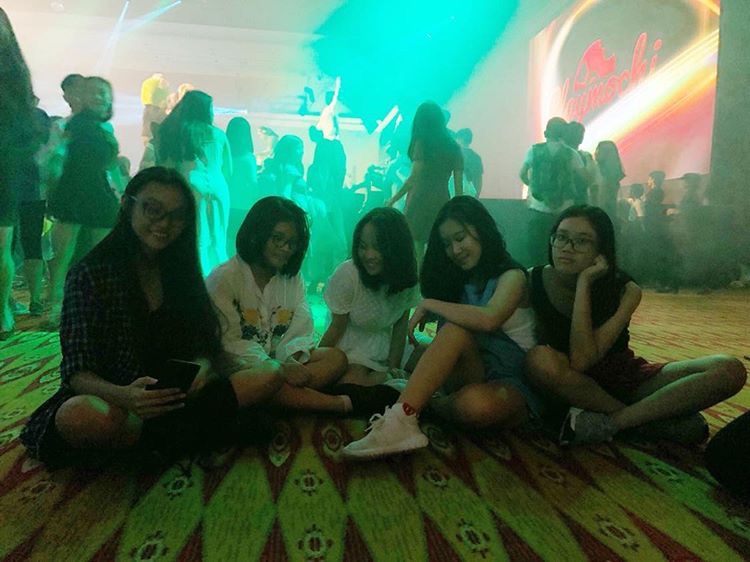
The Scholar’s Ball encourages mingling, dancing, and the chance to “look sharp”. Students are required to come in formal wear. Some scholars refer to it as a “pseudo-prom” or “nerd-prom”. It was introduced to allow students mingle with students from different countries.[12]
The Scholar’s Show
Since its inception, The Scholar’s Show has grown from a spontaneous talent show to a showcase of students’ ambition, skill, and bravery. Student performances range from vocal and instrumental performances to beat boxing, dancing, and magic tricks. The Scholar’s Show is meant to bring students together by introducing them to mutual talents and interests. The Scholar’s Show is held at all two-day rounds, and at each Global Round and the Tournament of Champions.
Flag March
The Flag March happens at the end of every Global Round and Tournament of Champions before the Awards Ceremony. In the Flag March, there is one representative (flag bearer) from every country participating in the World Scholar’s Cup. The flag bearers carry the flag of their country and march to the stage.[14]
Awards Ceremony
The Awards Ceremony, also known as the Closing Ceremony, takes place just before everyone says their goodbyes. Traditionally, staff members stand on stage and announce the winners for the entire round.
WSC 2018
In 2018, Havana is the theme song. Scholars have claimed that the song has been played over 100000 times across the various Global Rounds.[22] They have also performed an original song at each global round titled “Remember that We’re Non-Violent.”
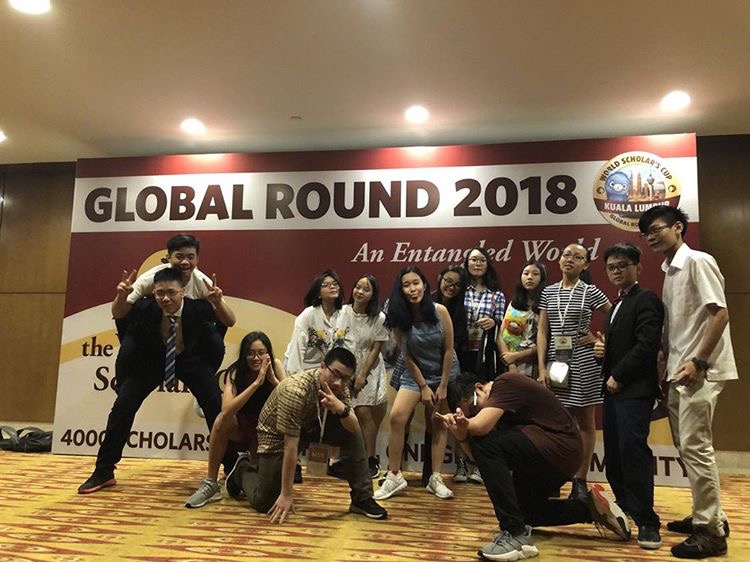
WSC 2018 với chủ đề “An Entangled World” bao gồm ba vòng:
- Vòng 1 (Region Round): 31/3 – 1/4/2018 tại TP. HCM và 12 – 13/5/2018 tại Hà Nội.
- Vòng 2 (Global Round): Từ 18/6/2018 – 23/6/2018 tại Malaysia
- Vòng 3 (Tournament of Champions): diễn ra tại ĐH Yale, Hoa Kỳ


Nguồn: Wikipidia
 Vi Nguyễn